

At the beginning of last year I decided that what I really needed to improve my paintings of cities was a wide angle camera lens. I had seen some paintings in which scenes of an urban nature were bent and distorted as if painted from photos taken through a fish-eye lense or as seen in a convex mirror. This seemed to really suit the nature of the subject: tall buildings loomed and long roads bent around the picture fitting in lots of interesting details. I got myself the cheapest wide angle lens I could find and went off around Salamanca taking photos of plazas and churches, monastaries and parks. As with so many things in life it wasn't quite as easy as it seemed as the distortion I was so much craving was just too much, if I tilted the camera too high the trees and buildings fell away in a very unreal manner. I got home and uploaded the photos onto my computer to find that many of them weren't suitable for painting, as I have often found when painting spectacular sunsets, if a photo doesn't look real then a painting of it certainly won't. As the year passed I found that I used the wide angle lens less and less, usually opting for the one I got with the camera. In fact the function for taking 360 degree photos on my smart phone seems to achieve results more like what I was imagining in the beginning than this expensive camera lens
Anyway, of the photos I took I did do a couple of paintings, here is one of a church, the Iglesia de San Martin behind la Plaza Major. I had the presence of mind to take photos of the painting process and here it is, step by step. If you want to see the photos in more detail then click on the image and it will bring them up full size.
After I finished this painting I kept it for a while and then eventually painted over it with something else, to be honest I'm not sure which painting I convered it with, maybe one day my work will become collectable and an art museum will x-ray each painting to find half a dozen other paintings under each one. It's not that I disliked the painting but it was rather big and I could see an even better painting waiting to take its place on the canvas. I paint as a hobby so I see each painting more as an opportunity to learn than something that will make me money, and my walls are already too full with my favourite paintings to fit any more. My collection is a brutal example of natural selection, if I like something I have painted then it goes on the wall, but it has to be better than what is already there to replace something. If there is no space for it then it sits on one of my easles until it is dry and then gets put in a pile of paintings in a corner or, if it's really bad and may be embarrassing if seen by a visitor it gets put in a cupboard. If I don't have any blank canvases to paint on when I get the idea for a new painting then I just grab my least favourite in the pile and paint over that. And so happened with this painting, now it only exists in digital form. And so natural selection picks off the weak paintings and leaves my collection stronger.

I began with a yellowish undercoat, as usual I was using some old paint left over from another painting so the yellow went on in an uneven manner as I mixed it with more white and then more yellow. As the strange wide angle was important I took time to get the lines of the building and the pavings an the floor at correct angles.


I approach the addition of detail differently in each painting, in this case I added all the shadows and dark lines first over the underpainting to preserve the pencil drawing underneath the undercoat.
Here I am adjusting the colour of the sky so that it doesn't look so muddy and I can get the rest of the colours correct in relation to it.
 Next the lightest points on the painting went in. I think I made the church too white and this was a reason for me eventually painting over this. In fact most of the stone in the historical centre of Salamanca is a beautiful yellow somewhere between naples yellow and yellow ocre.
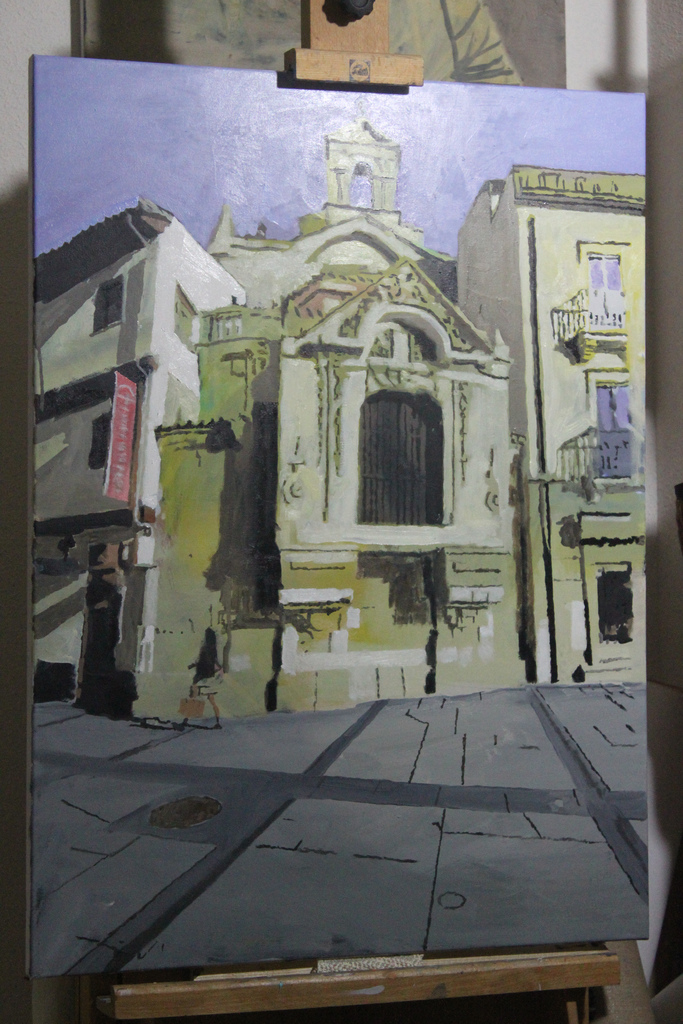 I keep adding blocks of colour, here the bottom of the church is being painted in.
 As the painting begins to take shape I have to adjust some of the yellow underpainting as it was beginning to look harsh in relation to the rest of the tones.
 I keep working to get everything balanced.
 Here I've painted the pavings a more accurate tone. Click on the image to get a better idea of what is changing.
 In this photo I am getting rid of more of the underpainting, filling in between the gaps.
 Here is a close up of me adding some detail, I like to use a brush bigger than I think I can handle and then the final result looks less over-worked.
 The finished painting, as seen on the easle.
 As usual I try to take a photo where there is no light reflected on the painting, then I crop the photo on a photo editor and sometimes adjust the levels if the light I have taken the photo in is too yellow. I always try to get it looking the same as in real life, sometimes it can be nice to up the contrast a bit, but it's easy to go to far and lose some of the subtlety of the actual artwork.


